Tells the total size of the header since it could have bits in the Options’s field.
The value represents itself multiplied by a 4-byte increment. Example: If the value 5 is represented here, it says that the header has a total size of 20 BYTES
Minimum value = 5 (20 Bytes)
Maximum value = 15 (60 Bytes)
DSCP = Differentiated Services Code Point (6 Bits)
Used for QoS
Its value tell the priority of the packet
ECN = Explicit Congestion Notification (2 Bits)
Node-to-Node communication that tells the congestion of the network without dropping packets
Endhosts and the network infrastructure must support it
Total Length (16 Bits)
Tells the length of L3 Header + L4 Segment
Minimum Size is 20 (L3 Header without encapsulated data)
Maximum Size is 65,535
Identification (16 Bits)
Identifies if a packet is fragmented.
If a packet has been fragmented, due to the fact of being larger than the MTU (Maximum Transmission Unit), the fragments will have the same identification value in order for them to be reassembled in the receiving host
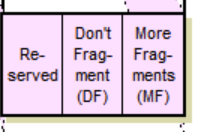
Flag (3 Bits)
Used to control/identify the fragments
Bits:
Bit 0: Reserved, always set to zero
Bit 1: Don’t Fragment, if is 1 the packet should not be fragmented
Bit 2: More Fragments, if is 1 it signals there is more fragments to come, and 0 if it is the last fragment
A unfragmented packet will have the More Fragments bit set to 0
Fragment Offset (13 Bits)
Used to tell the position of the fragment in the unfragmented packet.
This gives a way to reassemble a packet even if the fragments arrive out of order.
Time To Live (8 Bits)
Indicates the quantities of router hops.
Usually the TTL is 64, and is decreased by 1 by each time it arrives in a router
Prevents Looping
Protocol (8 Bits)
Tells the L4PDU Protocol used:
TCP: 6
UDP: 17
ICMP: 1
OSPF: 89 (Dynamic Routing Protocol)
Header Checksum (16 Bits)
It is used to detect errors in the IPv4 Header, not the encapsulated data, that is done by the checksum on Layer 4
If the newly calculated Checksum from the header doesn’t match the value on this field, the packet is dropped.
Source IP Address (32 Bits)
Lists the IP address of the host that sent the packet
Destination IP Address (32 Bits)
Tells the IP address of the intended receiver of the packet
Options (0-320 Bits)
Rarely used, it is used when the IHL has a value greater than 5